
Notes · 19 August 2026
When the office becomes a 2 MW compute node.
Etched’s San Jose headquarters blurs the line between workplace, laboratory and digital infrastructure. It is an unusual case, but it points to a broader requirement: energy flexibility will need to move closer to where compute is deployed.
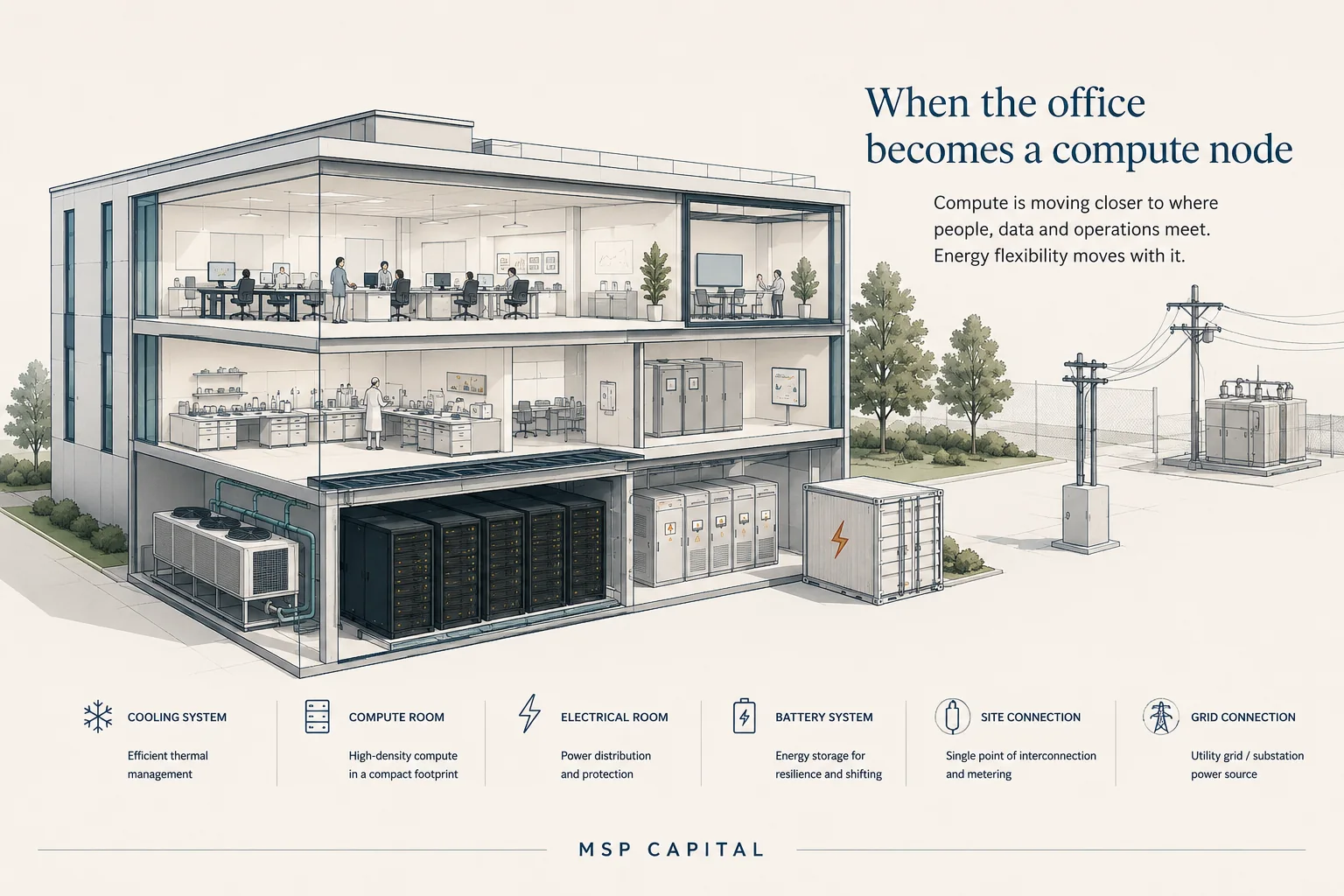
On 18 August, Etched announced a further US$700 million funding round at a US$21 billion valuation. The financing is notable. The physical infrastructure behind the company is more instructive.
Etched says its San Jose office includes an NPI prototyping facility and a 2 MW data centre operating around the clock. It has also opened an 80,000-square-foot Milpitas facility planned to support an NPI laboratory, an in-house surface-mount line and expanded deployments, with expected power use of up to 10 MW as the site develops.
This is not an ordinary office server room.
Etched is an edge case, but a useful one. It shows how specialised compute can turn an ordinary-looking workplace into a material energy asset—and why power architecture now belongs in the operating plan.
It does show that the boundary between workplace, laboratory and data centre can blur. Private AI, edge processing and specialised inference can place meaningful compute closer to data, equipment and users. Hyperscale data centres remain essential; they may increasingly coexist with embedded compute in offices, factories, hospitals, laboratories and campuses.
At that point, electricity is no longer simply a facilities expense. It becomes part of the operating architecture.
The power problem operates at more than one timescale.
Compute loads can create fast, rack-level fluctuations as well as longer site-level peaks. These are related problems, but they are not solved by the same equipment.
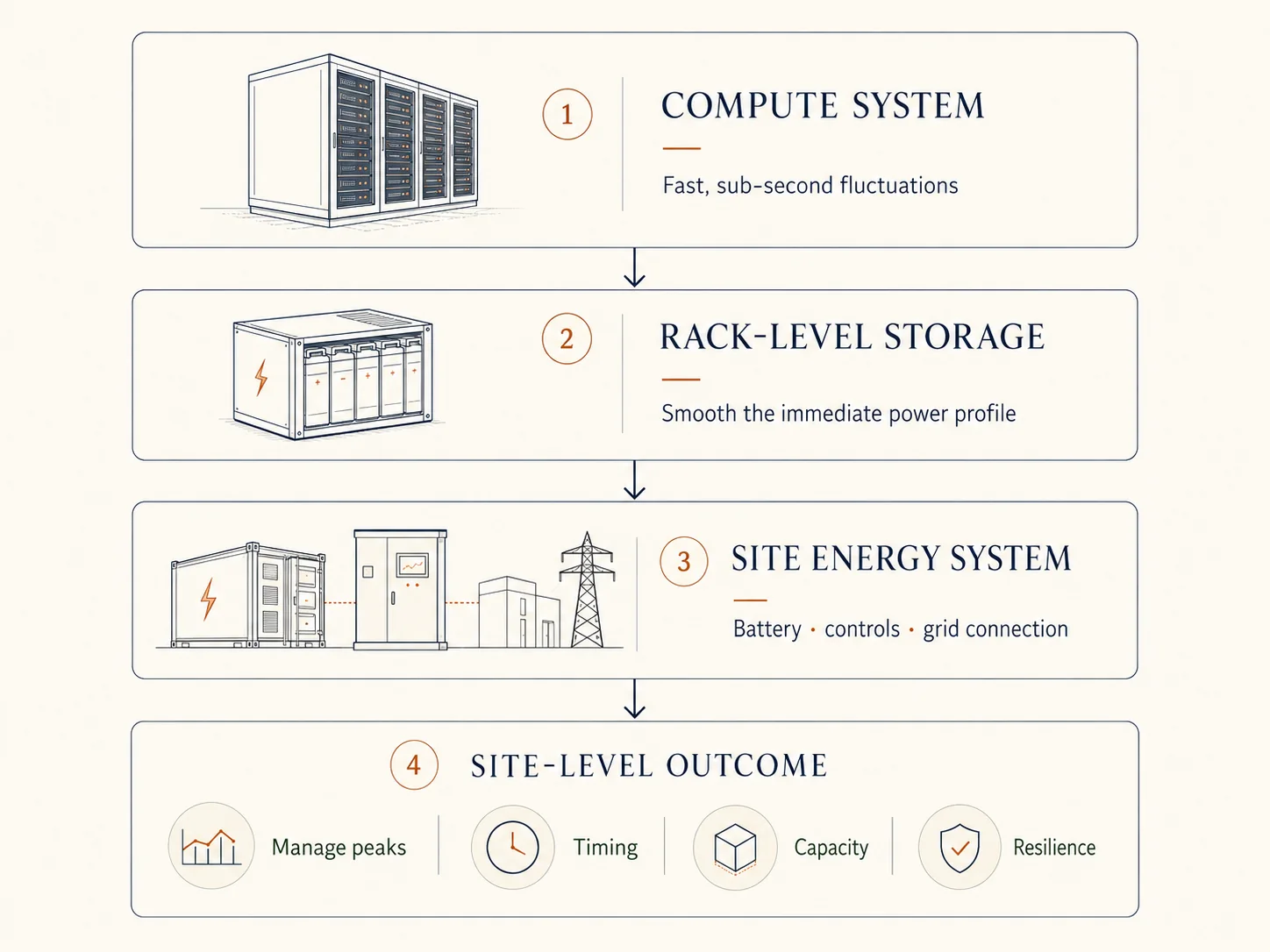
NVIDIA’s GB300 NVL72 design integrates energy storage into power shelves to smooth very short power transients. In one published test using the same rack and workload, the storage-enhanced power supply reduced the peak power demand presented to the grid by 30% while substantially damping rapid fluctuations.
Site-level battery storage and controls address a different layer. They can help manage site peaks, preserve connection headroom, shift the timing of electricity purchases and support resilience. Rack-level and site-level storage are therefore complementary: one manages rapid internal variation; the other manages the wider relationship between the site and its connection.
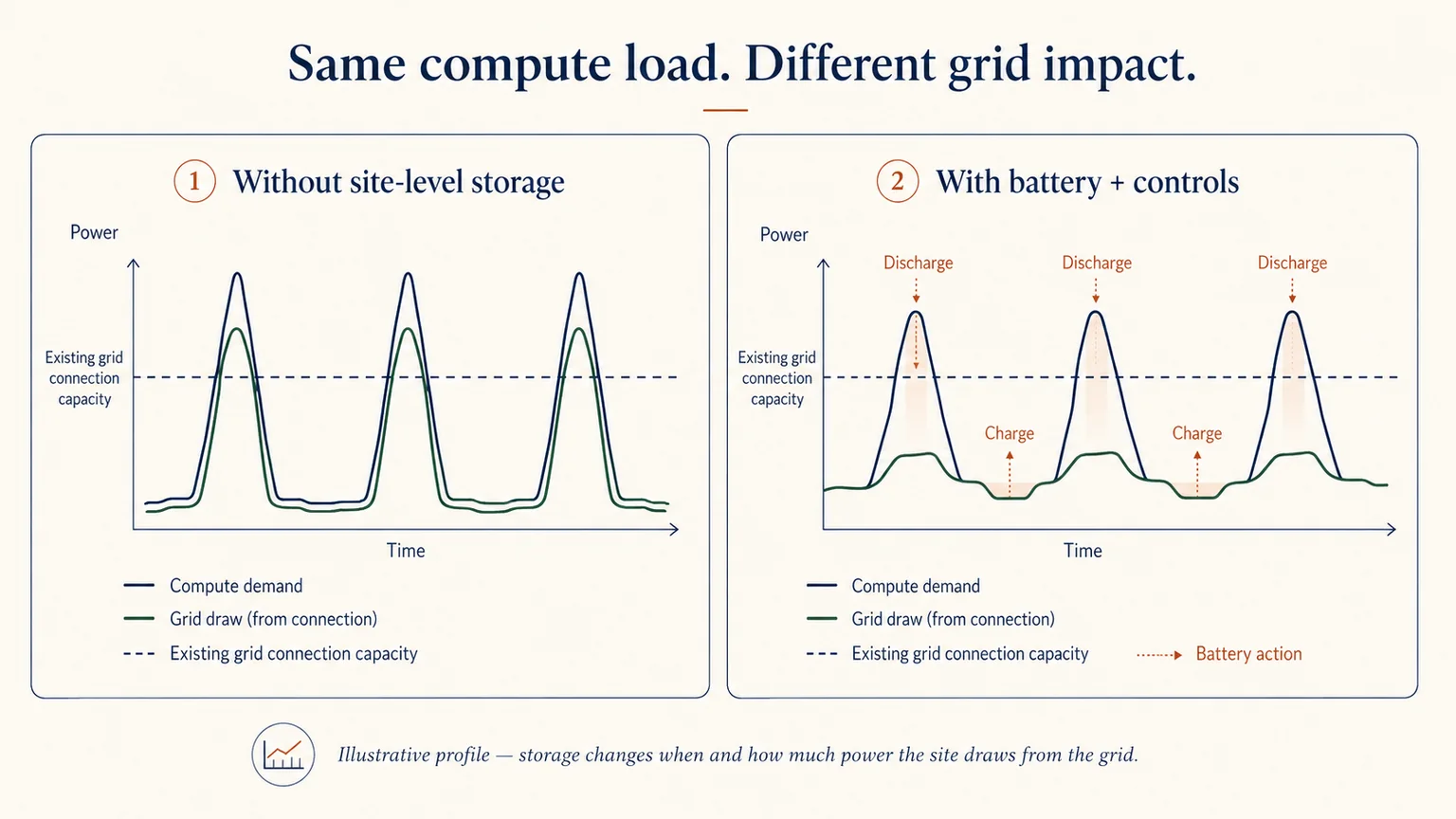
Storage does not remove the need for an adequate grid connection. A battery cannot indefinitely support a continuous load beyond the capability of the connection and the energy available to recharge it. Its value is in separating part of the instantaneous power requirement from the continuous grid requirement, within a properly designed operating envelope.
Two infrastructure pathways.
The transition will not follow a single model. Large, purpose-built campuses need power-ready environments designed for sustained compute demand. MSP is examining the infrastructure requirements associated with this larger-scale pathway through DataParks.
Existing commercial and industrial sites present a different pathway. Through DERCO, MSP is developing site-connected storage and energy-flexibility infrastructure for suitable operating environments. The objective is not to turn every site into a data centre. It is to assess whether storage and controls can improve the way a credible compute load interacts with its existing connection.
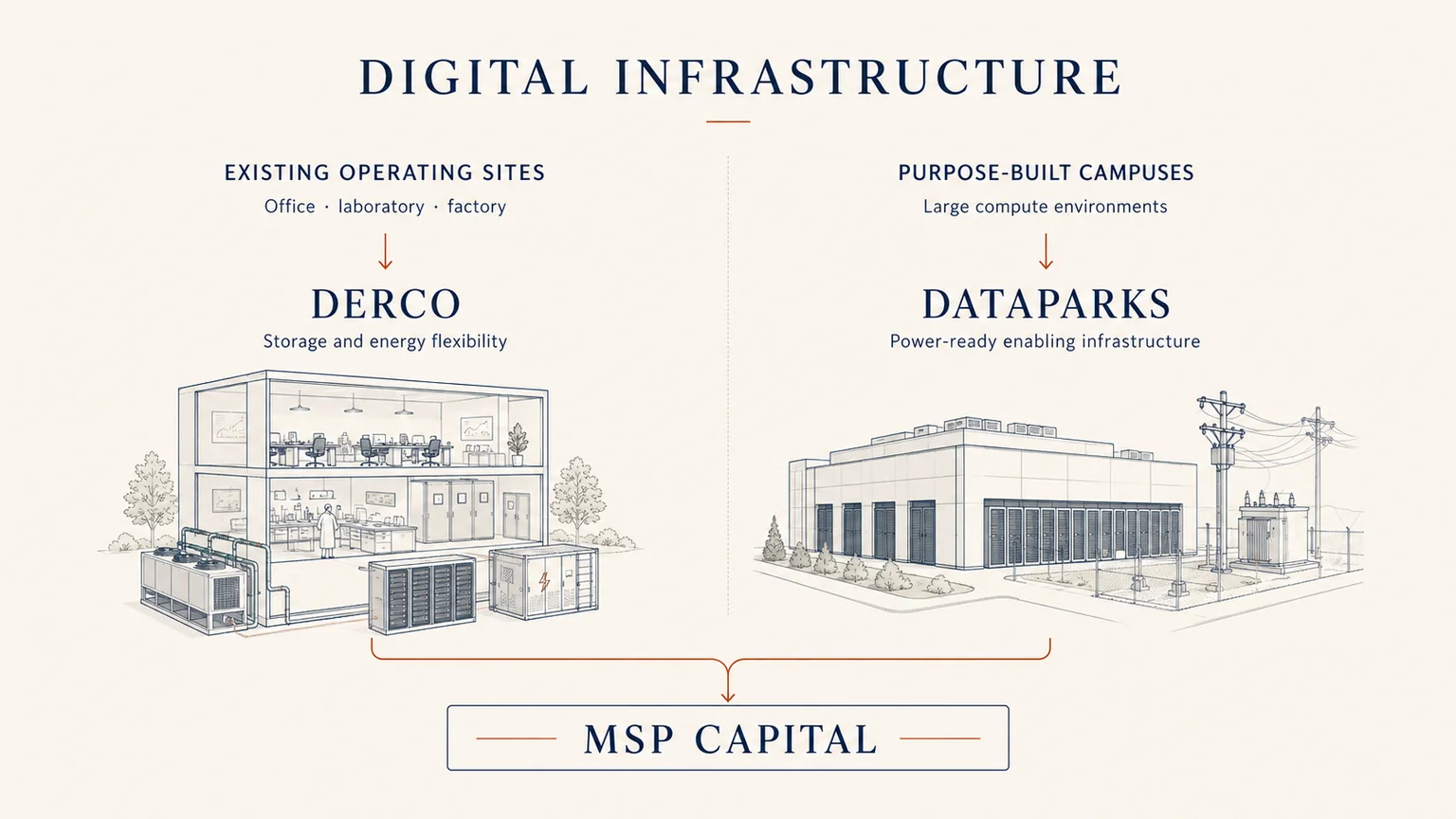
Etched sits between these worlds: a high-intensity compute company operating meaningful digital infrastructure inside a headquarters and laboratory environment while also developing a larger dedicated facility.
The broader trend is not that all compute will decentralise. It is that compute will appear in more locations, at more scales and for more specialised purposes. As compute moves closer to the user, energy flexibility will need to move closer to the compute.
Sources
- Etched, “From Zero to One”, 18 August 2026.
- Etched, July 2026 financing and facilities announcement.
- NVIDIA, “How New GB300 NVL72 Features Provide Steady Power for AI”.
- International Energy Agency, “Key Questions on Energy and AI”, 2026.